PROVISION OF COURSE PLACES
The Common Core Program (“the Program”) is a major component of the undergraduate curriculum. Students are required to complete their common core requirements by taking courses from a range of common core areas for their respective curriculum. To ensure a balanced mix and spread of courses available each term, and to provide students with a reasonable number of course choices to select from in these areas, the Undergraduate Core Education (UCE) Team will provide a projected demand for common core course places to facilitate Schools in effectively planning the courses to be offered.
The UCE Team will collect statistics on the common core places provided and student enrollment for monitoring the overall provision and offerings of common core courses, which in turn inform the future planning of course offerings, help analyze student enrollment patterns, and monitor students’ progress toward the completion of their common core requirements. These statistics are reported to the Committee on Undergraduate Core Education (CUCE) periodically.
TEACHING AND LEARNING QUALITY
To ensure and enhance the quality of the Program, regular monitoring of course delivery and outcome standards is conducted. The UCE Team gathers various feedback from students and instructors during the year. Course documentations are also collected to support the review of the alignment between course content, pedagogy, and assessment with the intended learning outcomes (ILOs) of the common core courses and their associated common core areas.
Major course monitoring activities include the following:
Student Feedback on their Learning Experience
Student feedback is an essential element in monitoring the quality of a course as experienced by learners. Their views are gathered through the following channels:
- Quantitative Data
- Student Feedback Questionnaire (SFQ) (course overall mean scores)
SFQ is administered by the Academic Quality Advancement (AQA) Team of the Academic Registry (ARO) for all courses at the end of each term to collect feedback from students on their course learning experience.
The UCE Team collects from the AQA Team the course overall mean scores of the SFQ to get a general overall rating by students about these courses. A summary of the statistics and the observations derived from the statistics is submitted to CUCE for review.
The Academic Director (UCE) may approach individual department heads to discuss courses with unusual SFQ scores.
- Common Core Questions in SFQ
Apart from the course overall mean scores, the following three questions in the SFQ are used to analyze the effectiveness of common core courses in achieving the learning outcomes, as well as to assess the extent to which the courses arouse students’ learning interest and support their development of important competencies.
Q2: The course (including course content, teaching materials, learning activities) helped me achieve the course intended learning outcomes.
Q4: The course helped me acquire important skills for my personal and /or professional development (e.g., critical thinking, problem-solving, communication).
Q5: The course (including course content, teaching materials, learning activities) stimulated my interest in this subject.
- Survey on Common Core Courses Conducted as Part of the First Year Experience Survey (FYES)
Two questions related to common core courses are included in the FYES [please divert to a new webpage, showing the questions. File: FYES_20260612], which is administered by the AQA Team in the second half of the Spring term. It aims to collect feedback from first-year undergraduate students on their perceptions of the values of taking common core courses.
- Survey on Common Core Courses Conducted as Part of the Student Engagement and Satisfaction Questionnaire (SESQ)
The same two questions from the FYES regarding students’ perceived values of common core courses are also incorporated into the SESQ. The purpose is to collect feedback from final-year undergraduate students, facilitating the tracking of feedback on these aspects from the same cohort throughout their studies at HKUST.
- Student Feedback Questionnaire (SFQ) (course overall mean scores)
- Qualitative Data
- Student representative in CUCE
Student views and feedback can be represented through the student representative serving on CUCE. Through the student member, students can contribute to the discussions and decision-making about the curriculum and other teaching and learning matters regarding the Program.
- Student Focus Group
Student Focus Group studies are conducted on an ad-hoc basis as needed to gather students’ views toward their learning experiences with common core courses, and their insights or new ideas about specific common core issues. In general, students are selected mainly from amongst those with year-2 standing or above as they typically have relatively more experience with common core courses.
- Student representative in CUCE
Instructor Teaching Experience
The commitment and academic expertise of the teaching staff are crucial to the delivery of high quality courses. It is important to learn from instructors their feedback on their experiences in developing and teaching common core courses, as well as their assessments of whether these courses have achieved the area ILOs. Noteworthy issues or good practices noted from the feedback will be communicated and shared with Schools and other instructors.
- Instructor Self-Review (ISR)
The ISR [please divert to a new webpage, showing the questionnaire. File: ISR Form_20260610] is conducted at the end of each term in the form of an online questionnaire. It provides quantitative feedback from instructors on their self-assessment of the extent to which their courses have achieved the course ILOs, area ILOs, and competency education.
It also provides qualitative feedback through written comments, where instructors can share their responses to student feedback, identify good practices in teaching and assessment, and provide suggestions for solving difficulties they have encountered during course delivery.
Information collected from the ISR will facilitate the four-level course review process (see Course Review [jump to “Course Review” in this section] for details).
- Instructor Focus Group
Organized in the form of small groups, the ad-hoc instructor focus group serves as a collegial platform for friendly, mutual sharing among instructors regarding effective teaching practices. It collects instructor feedback on their experiences in teaching and developing common core courses, and helps identify their needs, expectations, and challenges. It is also useful for soliciting ideas and suggestions for achieving the goals and objectives of the Program.
Jointly developed by the UCE Team and the Information Technology Services Office (ITSO), the Common Core Course Management System (CMS) serves to collect a wide range of common core statistical data, archive documentation, and produce statistical reports and analysis for informing program quality and future planning. The UCE Team administers the system and data acquisition and uses the system to monitor the quality of the Program. Relevant reports will be shared with Schools and other units as appropriate.
COURSE REVIEW
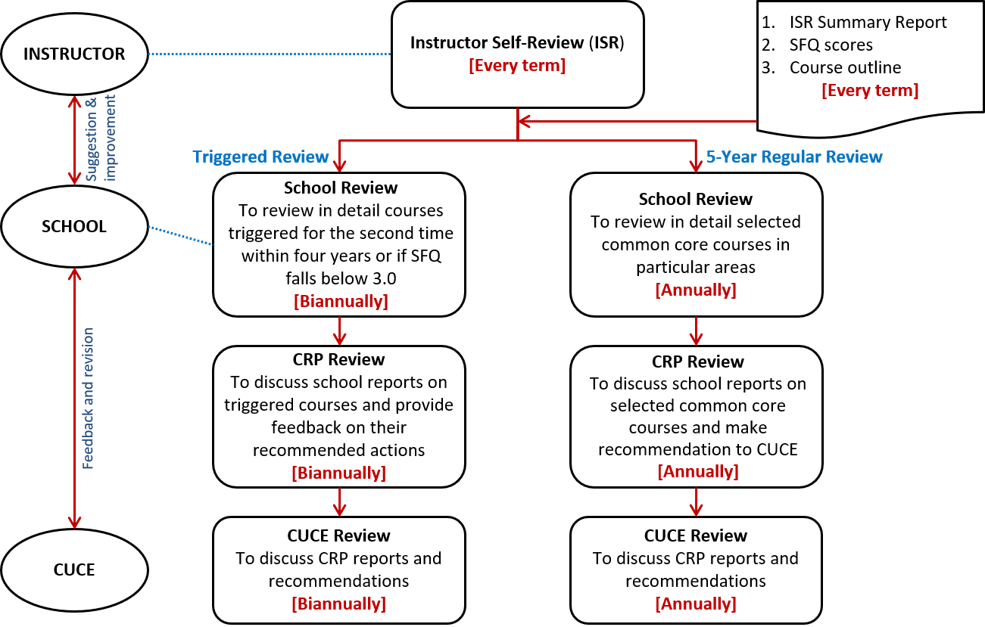
Course review is a four-level internal review process involving instructors, Schools, Course Review Panel (CRP), and CUCE for monitoring the effectiveness of common core courses in achieving their course ILOs, their respective area ILOs, and their chosen competencies when they were offered. Instructors provide inputs about the teaching and learning effectiveness in their courses through the instructor self-review process. Schools review the summary reports of the instructors’ self-reviews on a biannual basis, and identify, based on the “trigger criterion” adopted by each School, courses that call for timely attention and follow up. Schools also undertake in-depth regular review of common core courses on a 5-year cycle. CRP provides insights into course delivery within common core areas and reports to CUCE any issues identified and their recommendations for further consideration.
Instructor Self-Review (ISR)
- The instructors play a critical role in the delivery of common core courses. The ISR offers a platform for instructors to undertake a timely self-reflection on course teaching and learning, to share good practices on teaching and assessment, the challenges faced and proposed solutions, and to explore or suggest ideas for improvements in the next offering. The ISR is conducted online at the end of each term, covering all common core courses offered in the term. All course instructors are asked to indicate their assessment of whether their courses have achieved the course ILOs as stated in the course outline, the ILOs of the common core areas in concern, as well as the chosen competencies. They are also invited to review the student feedback they collected through mid-term surveys, end of term SFQ, or other means, and suggest actions for improving the course where applicable. They will have access to the ISR forms they completed in previous terms.
- Information collected from the ISR are summarized by School and common core areas and made available to Schools, Departments, the CRP concerned, and CUCE to facilitate the course review process for course improvement and enhancement.
School Reviews
Schools will conduct two types of reviews: the “triggered review” and the “5-year regular review”. These reviews are primarily based on summary reports from instructors’ self-reviews, SFQ scores, and the course outlines that are routinely collected by Schools every term; as well as other course materials such as major assessment samples, which are available on request.
- Triggered Review
- The triggered review aims at enhancing the quality of the courses and their delivery, but not for evaluating the performance of the instructor. The main purpose is to identify courses that might need timely attention and follow-up actions after an offering. These courses are identified by means of the “trigger criterion”. Triggered reviews are conducted biannually, with one covering courses offered in the Fall and Winter terms, and another covering courses offered in the Spring and Summer terms.
- CUCE adopts SFQ course overall mean score of 3.20 as the minimum threshold trigger criterion. Schools may set a higher trigger score than 3.20. Common core courses receiving a SFQ course overall mean score below the trigger criterion in a term (3.20 or a higher score set by Schools) will be triggered for review. Information such as course outlines, SFQ scores, and ISR reports will be made available to help the reviewers understand the overall performance of the courses.
- When a course is triggered for review, the School will request the Head of the course offering Department to discuss the course with the instructor and report the review outcomes to the School. The Department Head and instructor will work together to review the course teaching, identify what the challenges are, suggest solutions to tackle them, and monitor the implementation of the improvement measures. Schools will coordinate with departments to ensure that issues identified are addressed and to facilitate courses to make improvement.
- If a common core course is triggered for the first time, an internal review by the School will be undertaken without the need to submit a report to CUCE. However, if the same course is triggered a second time within four years, a School Triggered Review Report will be required. School will report its observations on the triggered course on a standard form [please divert to a new webpage, showing the form. File: School TGR Report_20260612], together with recommended actions (if any) with target completion date. Triggered courses will be monitored until their SFQ score has improved to be above the trigger criterion. The guidance notes [please divert to a new webpage, showing the notes. File: Guidance Notes on School TGR_20260610] for conducting the triggered review should be observed.
- For any common core courses that receive an SFQ course overall mean score below 3.0 at any offering, the School is required to conduct a review and submit a report to CUCE.
- 5-year Regular Review
- The 5-year regular review is intended to foster a holistic perspective that enhances curriculum effectiveness and supports the attainment of Common Core goals. A comprehensive review of 10 courses or 25% of representative courses, whichever is greater, from each of the hosting common core areas under the Broadening group will be conducted at 5-year intervals.
- Using the specified template [please divert to a new webpage, showing the template. File: School Regular Review Report_20260612], Schools will report to the respective CRP their observations on the courses reviewed, including the relevance of course ILOs to the areas, the achievement of chosen competencies, and the effectiveness of the teaching and learning activities and assessment tasks; highlight good practices; summarize problems or difficulties encountered; and recommend follow-up actions to be completed with a specified timeline. The guidance notes [please divert to a new webpage, showing the notes. File: Guidance Notes on School Regular Review_20260612] for conducting the 5-year regular review should be observed.
CRP Review
Upon receiving the review reports from Schools (both triggered reviews and 5-year regular reviews), the UCE Team forwards the reports to the CRP concerned. The CRP discusses the issues identified and actions proposed to address the issues, evaluates data related to course delivery from the regular reviews from each School, examines the effectiveness of course delivery across Schools in achieving the area ILOs, and identifies courses for which improvement is essential to achieve the area ILOs. The CRP may, where deemed necessary, make reference to individual ISR forms and course outlines during the reviews. Comments and recommendations will be reported to CUCE for further discussion.
CUCE Review
CUCE receives and discusses the recommendations from CRPs (both triggered reviews and 5-year regular reviews). CUCE review focuses on the overall quality of common core course delivery across all areas, providing feedback to Schools its observations and general recommendations for improvement, highlighting good practices that can be shared among Schools, and ensuring that the recommended actions are followed up by Schools. Schools should incorporate their actions in response to recommendations from CUCE in their annual quality assurance reports on teaching and learning that are submitted to the Committee on Teaching and Learning Quality (CTLQ).
REPORTING ON MONITORING ACTIVITIES
The progress of implementing the quality monitoring activities together with the information collected and the issues identified in the process will be presented to CUCE and CTLQ for review.