Competency Education
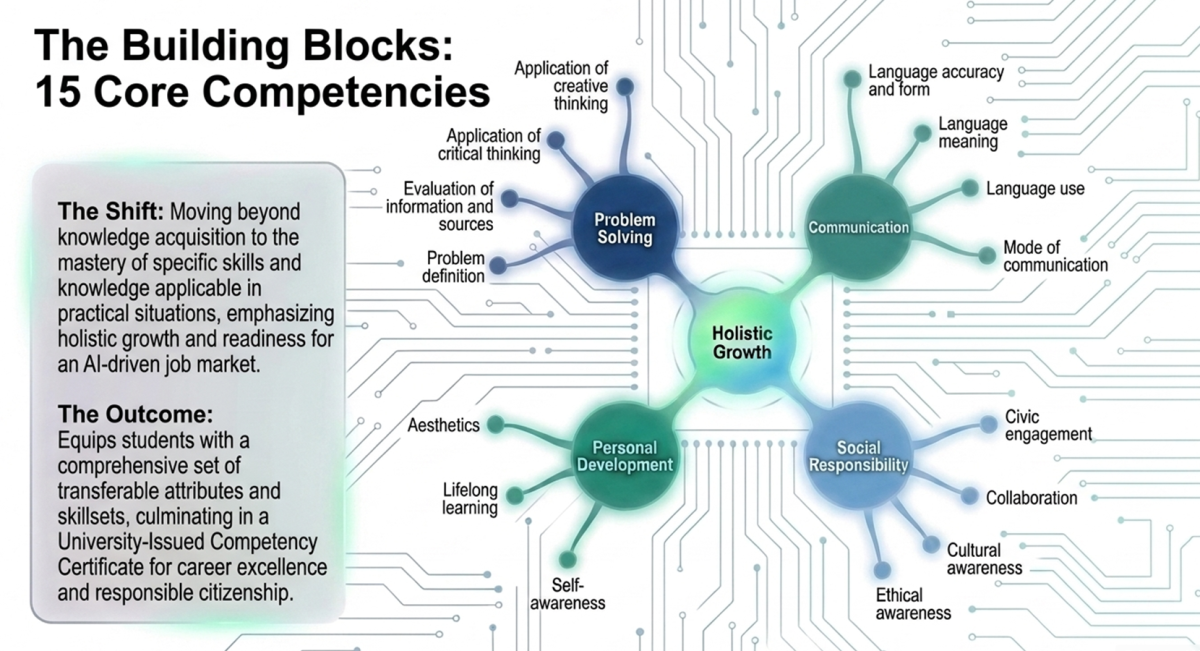
Competency education is essential for preparing you to thrive in both academic settings and real-world environments. This approach goes beyond mere knowledge acquisition; it emphasizes the development of skills necessary to apply that knowledge effectively across various contexts. At HKUST, we are dedicated to equipping you with a comprehensive set of attributes and skillsets that promote holistic growth.
In today’s rapidly evolving job market, where junior-level positions are increasingly being replaced by AI tools, graduates must not only have expertise in their specific fields but also possess transferable skills to navigate complex challenges. Our competency education framework cultivates this readiness by focusing on the mastery of specific skills and knowledge applicable in practical situations.
The 15 competencies
The Common Core Program has identified a total of 15 sub-competencies categorized under 4 broad competencies that are essential for your development as a future graduate. These competencies reflect our commitment to holistic education and are designed to empower you to excel in your career path while also becoming informed and responsible citizens.
By aligning our competencies with ABC LIVE, we aim to foster critical skills essential for your success. Each sub-competency not only prepares you to acquire knowledge but also helps you develop practical skills needed for your future roles. These essential competencies will be taught and assessed alongside academic knowledge, ensuring a comprehensive educational experience.
Broad Competency: Communication
CM01 Language accuracy and form
- Use language (grammar, pronunciation, vocabulary) accurately in writing and orally
- Use contextually appropriate language (e.g. formal style, informal style, word choice) in writing and orally
CM02 Language meaning
- Develop ideas clearly and fully
- Organize ideas coherently from sentence to text level (in speaking and writing)
CM03 Language use
- Interact with participants when speaking
- Demonstrate awareness of audience in communication
CM04 Mode of communication
- Use body language to enhance communication
- Use a range of modes (e.g. audio, graphics) for communication
Broad Competency: Personal Development
PD01 Aesthetics
- Articulate and apply judgment of aesthetics
PD02 Lifelong learning
- Design and implement realistic self-directed learning plans
- Manage own learning by employing learning techniques and strategies
PD03 Self-awareness
- Demonstrate external self-awareness (i.e. articulate and evaluate how other people view oneself)
- Demonstrate internal self-awareness (i.e. articulate and evaluate how one sees themselves)
Broad Competency: Problem Solving
PS01 Application of creative thinking
- Generate and apply creative ideas to solve problem
- Explain the existing situations in creative ways
- Refine and reiterate process to come up with creative solutions
- Practice divergent thinking
PS02 Application of critical thinking
- Apply evidence-based solution
- Provide unbiased judgment to analyze problem
PS03 Evaluation of information and sources
- Identify relevant sources/information
- Analyze and synthesize information from sources
- Evaluate the quality of information and sources
- Provide evidence-based argument
- Draw conclusions by synthesizing different skills such as analytical, quantitative reasoning, and critical thinking
PS04 Problem definition
- Analyze the given problem in relevant contexts
- Identify the key issue
Broad Competency: Social Responsibility
SR01 Civic engagement
- Demonstrate the ability to consider about civics and politics
- Demonstrate readiness to contribute to society as a responsible, caring citizen
SR02 Collaboration
- Work collaboratively in a team
- Identify and utilize own and other people’s different skills, strengths and weaknesses
SR03 Cultural awareness
- Demonstrate an understanding of own culture
- Apply an understanding of cultural diversity to interact with individuals from different backgrounds
SR04 Ethical awareness
- Recognize and address ethical issues as they arise
- Explore and evaluate the ethical implications of people’s actions
Reference Link:
Future-ready competency: https://www.studyinternational.com/news/future-skills-weffi/
https://teach.com/blog/9-skills-students-need-in-the-future-workforce/
Definition of 5-point Rubric Scale
Your performance in competencies will be evaluated using standardized 5-point rubrics across all common core courses, ensuring consistency and clarity in measurement.
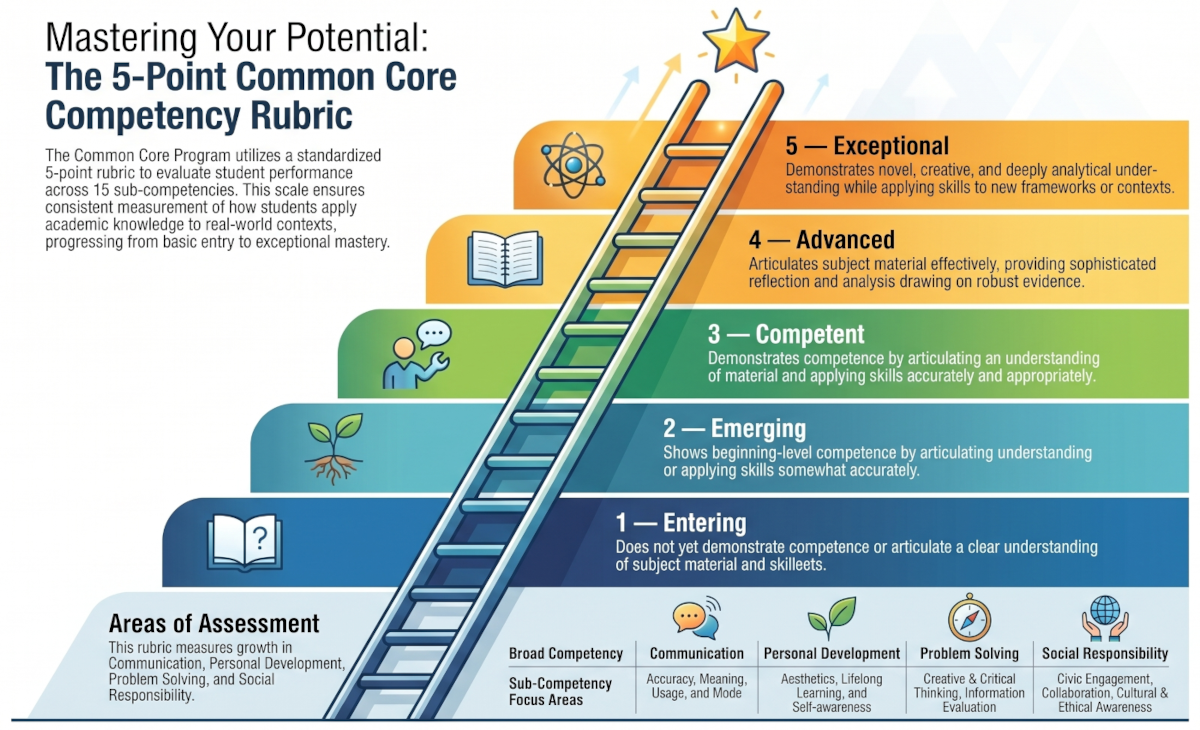
| 5 Exceptional | Demonstrates exceptional competence by articulating an understanding of subject material or applying a skill effectively and in a novel, creative, deeply analytical manner drawing on robust evidence; provides sophisticated reflection or analysis and applies this analysis to another framework or context. |
| 4 Advanced | Demonstrates advanced competence by articulating an understanding of subject material or applying a skill effectively and providing sophisticated reflection or analysis drawing on robust evidence. |
| 3 Competent | Demonstrates competence by articulating an understanding of subject material or applying a skill accurately or appropriately. |
| 2 Emerging | Demonstrates beginning level competence by articulating an understanding of subject material or skills application somewhat accurately or appropriately. |
| 1 Entering | Does not demonstrate competence; does not articulate an understanding of subject material or application of a skill set. |
Assessment Rubrics
CM01 Language accuracy and form
- Use language (grammar, pronunciation, vocabulary) accurately in writing and orally
- Use contextually appropriate language (e.g. formal style, informal style, word choice) in writing and orally
| 5 Exceptional | Uses language (e.g. grammar, pronunciation, vocabulary) exceptionally well in writing and orally; uses contextually appropriate, sophisticated, and nuanced language style in writing and orally. |
| 4 Advanced | Uses language (e.g. grammar, pronunciation, vocabulary) effectively in writing and orally; uses appropriate language style (e.g. formal style, informal style, word choice) effectively in writing and orally. |
| 3 Competent | Uses language (e.g. grammar, pronunciation, vocabulary) accurately in writing and orally; uses language style (e.g. formal style, informal style, word choice) appropriately in writing and orally. |
| 2 Emerging | Uses language (e.g. grammar, pronunciation, vocabulary) somewhat accurately in writing and orally; uses language style (e.g. formal style, informal style, word choice) somewhat appropriately in writing and orally. |
| 1 Entering | Does not use language (e.g. grammar, pronunciation, vocabulary) accurately in writing and orally; does not use language style (e.g. formal style, informal style, word choice) appropriately in writing and orally. |
CM02 Language meaning
- Develop ideas clearly and fully
- Organize ideas coherently from sentence to text level (in speaking and writing)
| 5 Exceptional | Develops well-framed ideas clearly and fully by applying a sophisticated professional and academic approach; organizes ideas from sentence to text level (in speaking and in writing) in novel, professional and academic manner. [Note: An extraordinarily well-written and well-articulated response, making extremely effective use of professional writing skills and academic convention.] |
| 4 Advanced | Develops well-framed ideas clearly, fully, and in a sophisticated manner; organizes ideas coherently from sentence to text level (in speaking and writing) in a nuanced, sophisticated manner. [Note: Well-written response; applies the skills of professional writing and academic conventions well and without error] |
| 3 Competent | Accurately and appropriately frames and develops ideas by articulating them clearly and fully; organizes ideas coherently from sentence to text level (in speaking and writing). |
| 2 Emerging | Begins to frame and develop ideas clearly and fully but does so only somewhat accurately and appropriately; organizes ideas coherently from sentence to text level (in speaking and writing) only somewhat accurately and appropriately. |
| 1 Entering | Does not develop ideas clearly and fully; does not organize ideas coherently from sentence to text level (in speaking and writing). |
CM03 Language meaning
- Interact with participants when speaking
- Demonstrate awareness of audience in communication
| 5 Exceptional | Interacts with participants in a creative or novel, and professional manner; demonstrates deep awareness of the audience in communication. [Note: Uses nuanced and subtle language, draws on detailed, context-specific examples, and applies highly appropriate stylistic choices in interactions with a given audience; analyzes and articulates these in an extremely clear and cogent way.] |
| 4 Advanced | Interacts with participants in an effective manner; demonstrates sophisticated awareness of the audience in communication. [Note: Uses nuanced language to communicate with an audience; engages examples that are appropriate to the audience in one’s communications.] |
| 3 Competent | Interacts with participants appropriately; demonstrates appropriate awareness of the audience in communication. |
| 2 Emerging | Interacts somewhat with participants when speaking somewhat accurately or appropriately; demonstrates some awareness of the audience in communication somewhat accurately or appropriately. |
| 1 Entering | Does not interact effectively with participants when speaking; does not demonstrate awareness of the audience in communication. |
CM04 Mode of communication
- Use body language to enhance communication
- Use a range of modes (e.g. audio, graphics) for communication
| 5 Exceptional | Uses body language in a creative and effective way; interprets and evaluates body language accurately; uses varied modes of communication and expression in a creative and novel manner; provides a deep analysis of the use of varied modes of communication. [Note: Expresses / articulates way communication occurs in an extremely well-organized and well-justified manner.] |
| 4 Advanced | Uses nuanced aspects of body language; interprets and evaluates body language accurately; uses varied modes of communication and expression in a sophisticated manner; provides a sophisticated analysis of the use of varied modes of communication. [Note: Expresses / articulates how communication occurs well and without error.] |
| 3 Competent | Uses body language in ways that are appropriate to the context; interprets and evaluates body language accurately; uses varied modes of communication accurately; provides an accurate analysis of the use of varied modes of communication. |
| 2 Emerging | Uses body language only in a manner that is somewhat appropriate to the context; interprets and evaluates body language only somewhat accurately; uses varied modes of communication in a manner that are only somewhat appropriate to the context; provides a somewhat accurate analysis of the use of varied modes of communication. |
| 1 Entering | Does not interpret, evaluate, or use body language; does not recognize or analyze the use of varied modes of communication. |
PD01 Aesthetics
- Articulate and apply judgment of aesthetics
| 5 Exceptional | Brings a novel, creative, and particularly sophisticated approach to appreciating aesthetics, by effectively articulating an understanding of aesthetics and drawing on robust evidence to inform an aesthetic analysis; applies an analysis of aesthetics to another framework or context. [Note: Presents an original perspective on an aesthetic experience or product.] |
| 4 Advanced | Articulates and applies an appreciation of aesthetics effectively, drawing on robust evidence to inform an aesthetic analysis. |
| 3 Competent | Demonstrates an appreciation of aesthetics by articulating an understanding of aesthetics accurately or appropriately. |
| 2 Emerging | Attempts to articulate an appreciation and understanding of aesthetics somewhat appropriately. |
| 1 Entering | Does not articulate or apply an appreciation of aesthetics. |
PD02 Lifelong learning
- Design and implement realistic self-directed learning plans
- Manage own learning by employing learning techniques and strategies
| 5 Exceptional | Designs and implements realistic self-directed learning plans that incorporate highly sophisticated and deeply analytical reflections; manages own learning by employing highly effective learning techniques and strategies. [Note: Reflects clearly and cogently about one’s own experience; supports conclusions about own experience with evidence / examples that are well articulated.] |
| 4 Advanced | Designs and implements realistic self-directed learning plans in an effective manner; employs effective learning techniques to manage own learning. |
| 3 Competent | Designs and implements realistic self-directed learning plans accurately; employs mostly effective learning techniques and strategies to manage own learning. |
| 2 Emerging | Designs and implements a somewhat realistic self-directed learning plan, or does so somewhat accurately; employs somewhat effective learning techniques and strategies to manage own learning. |
| 1 Entering | Does not design and implement realistic self-directed learning plans; does not employ effective learning techniques and strategies to manage own learning. |
PD03 Self-awareness
- Demonstrate external self-awareness (i.e. articulate and evaluate how other people view oneself)
- Demonstrate internal self-awareness (i.e. articulate and evaluate how one sees themselves)
| 5 Exceptional | Demonstrates exceptional external self-awareness by articulating and evaluating how other people view oneself in a respectful and particularly sophisticated manner; demonstrates exceptional internal self-awareness by deeply articulating and evaluating the nuances of how one sees themselves. |
| 4 Advanced | Demonstrates external self-awareness by articulating and evaluating how other people view oneself in a nuanced and sophisticated manner; demonstrates sophisticated internal self-awareness by articulating and evaluating the nuances of how one sees themselves. |
| 3 Competent | Demonstrates external self-awareness by articulating and evaluating how other people view oneself reflectively and clearly; demonstrates internal self-awareness by articulating and evaluating how one sees themselves in a reflective and clear manner. |
| 2 Emerging | Attempts to demonstrate external self-awareness by articulating and evaluating how other people view oneself only somewhat accurately or appropriately; attempts to demonstrate internal self-awareness by articulating and evaluating how one sees themselves only somewhat reflectively and clearly. |
| 1 Entering | Does not demonstrate external self-awareness; does not demonstrate internal self-awareness. |
PS01 Application of creative thinking
- Generate and apply creative ideas to solve problem
- Explain the existing situations in creative ways
- Refine and reiterate process to come up with creative solutions
- Practice divergent thinking
| 5 Exceptional | Generates and applies creative ideas to solve problems in a unique and exceptionally sophisticated manner; explains existing situations in novel ways in a unique and exceptionally sophisticated manner; refines and reiterates processes to come up with novel solutions in particularly unique and sophisticated ways; practices divergent thinking in highly sophisticated ways. [Note: Applies creativity in an uncommon or innovative way; provides a well-written or well-articulated discussion of a creative idea; generates solutions to problems that is highly extraordinary.] |
| 4 Advanced | Generates and applies creative ideas to solve problems in a highly effective manner; explains existing situations in creative ways in a highly effective manner; refines and reiterates processes to come up with creative solutions using sophisticated reflection and drawing on robust evidence; demonstrates divergent thinking particularly effectively. |
| 3 Competent | Generates and applies creative ideas to solve problems accurately; explains existing situations in creative ways; refines and reiterates processes to come up with creative solutions; demonstrates divergent thinking. |
| 2 Emerging | Attempts to generate and apply creative ideas to solve problems, or does so somewhat accurately; explains the existing situations in somewhat creative ways; refines and reiterates processes to come up with somewhat creative solutions; attempts to demonstrate divergent thinking or does so somewhat accurately. |
| 1 Entering | Does not generate and apply creative ideas to solve problems; does not explain the existing situations in creative ways; does not refine and reiterate processes to come up with creative solutions; does not practice divergent thinking. |
PS02 Application of critical thinking
- Apply evidence-based solution
- Provide unbiased judgment to analyze problem
| 5 Exceptional | Employs evidence in decision making and problem solving effectively to propose or implement innovative solutions; proposes or implements novel strategies to mitigate the effects of biases in problem solving and decision making. |
| 4 Advanced | Employs evidence in decision making and problem solving effectively to propose or implement sophisticated solutions; analyzes the existence of biases and their potential effects in decision making and problem solving and proposes sophisticated strategies to mitigate their effect. |
| 3 Competent | Employs evidence in decision making and problem solving accurately; identifies the existence of biases in decision making and problem solving accurately. |
| 2 Emerging | Employs insufficient evidence in decision making and problem solving; identifies the existence of biases in decision making and problem solving somewhat accurately. |
| 1 Entering | Does not apply evidence in decision making and problem solving; does not recognize the existence of biases in decision making and problem solving. |
PS03 Evaluation of information and sources
- Identify relevant sources/information
- Analyze and synthesize information from sources
- Evaluate the quality of information and sources
- Provide evidence-based argument
- Draw conclusions by synthesizing different skills such as analytical, quantitative reasoning, and critical thinking
| 5 Exceptional | Synthesizes high quality information and sources to provide evidence-based sound arguments; provides deep evaluation of the quality of information and sources; synthesizes varied skills such as analytical, quantitative reasoning, and critical thinking to draw novel conclusions. [Note: The evidence-based arguments have the quality of having appropriate judgment in relation to the evidence presented.] |
| 4 Advanced | Synthesizes high quality information and sources to provide sophisticated evidence-based arguments; provides sophisticated evaluation of the quality of information and sources; synthesizes varied skills such as analytical, quantitative reasoning, and critical thinking to draw sophisticated conclusions. [Note: Well-written or well-articulated analysis that draws on detailed evidence.] |
| 3 Competent | Identifies, analyzes and synthesizes relevant sources or information accurately; applies analytical, quantitative, or critical thinking skills accurately. |
| 2 Emerging | Identifies and analyzes information from sources somewhat accurately; applies analytical, quantitative, or critical thinking skills somewhat accurately. |
| 1 Entering | Does not identify or analyze relevant sources or information; does not apply analytical, quantitative, or critical thinking skills. |
PS04 Problem definition
- Analyze the given problem in relevant contexts
- Identify the key issue
| 5 Exceptional | Breaks down a problem in a highly sophisticated or novel manner to identify the key issue; analyzes the given problem in relevant contexts in a novel manner. [Note: A detailed / thoughtful / all-rounded problem definition that is especially well-written or well-articulated; with highly detailed attention to context.] |
| 4 Advanced | Breaks down a problem in a sophisticated manner to identify the key issue; analyzes the given problem in relevant contexts in a sophisticated manner. [Note: A well-written / well-articulated analysis of the key issue; detailed attention to context.] |
| 3 Competent | Breaks down a problem effectively to identify the key issue; analyzes the given problem in relevant contexts accurately. |
| 2 Emerging | Breaks down a problem partially; analyzes the given problem somewhat accurately. |
| 1 Entering | Does not break down a problem; does not analyze the given problem in relevant contexts. |
SR01 Civic engagement
- Demonstrate the ability to consider about civics and politics
- Demonstrate readiness to contribute to society as a responsible, caring citizen
| 5 Exceptional | Articulates a nuanced understanding of civics and societal development by making sophisticated, novel, or critical claims, based on evidence, and expresses thoughtfulness and readiness to contribute to society by demonstrating ways to put concern into action in response to these claims. [Note: Identifies a civic problem, topic, or issue that is original and unusual, and articulates an analysis of this issue in an extremely well-organized manner.] |
| 4 Advanced | Articulates advanced understanding of civics and societal development by making sophisticated critical claims, based on evidence, and expresses thoughtfulness and readiness to contribute to society by demonstrating ways to put concern into action. [Note: Identifies cogently and articulately about a civic problem, topic, or issue; provides an analysis based on evidence.] |
| 3 Competent | Articulates accurate understanding of civics or societal development by making accurate or appropriate critical claims and doing so without error; expresses an appropriately high level of concern and willingness to contribute to society. [Note: Identifies a relevant civic problem, topic, or issue.] |
| 2 Emerging | Begins to articulate an understanding of civics or societal development by making somewhat accurate and appropriate critical claims; expresses a beginning level of readiness to care about and contribute to society. |
| 1 Entering | Does not articulate critical understanding of civics or societal development; does not demonstrate readiness to contribute to society as a responsible, caring citizen. |
SR02 Collaboration
- Work collaboratively in a team
- Identify and utilize own and other people’s different skills, strengths and weaknesses
| 5 Exceptional | Approaches working within team settings in a novel, creative, insightful and/or highly sophisticated manner; identifies and utilizes own and other people’s different skills, strengths and weaknesses in a novel, creative, insightful, and/or highly sophisticated manner. |
| 4 Advanced | Brings sophistication to work within team settings; identifies and utilizes own and other people’s different skills, strengths and weaknesses in ways that are nuanced, appropriate and highly effective. [Note: Identifies and articulates some subtleties in team work communication and interaction.] |
| 3 Competent | Works collaboratively in a team setting in ways that are effective and productive; identifies and utilizes own and other people’s different skills, strengths and weaknesses accurately. |
| 2 Emerging | Attempts to work collaboratively in a team setting or does so only somewhat appropriately; attempts to identify and utilize own and other people’s different skills, strengths and weaknesses, or does so only somewhat accurately. |
| 1 Entering | Does not work collaboratively in a team setting; does not identify and utilize own and other people’s different skills, strengths and weaknesses. |
SR03 Cultural awareness
- Demonstrate an understanding of own culture
- Apply an understanding of cultural diversity to interact with individuals from different backgrounds
| 5 Exceptional | Masterfully articulates the nuances of understanding of one's own culture; demonstrates nuanced and deep understanding of cultural diversity by interacting with individuals from different backgrounds and reflecting on these interactions deeply and in a sophisticated manner. |
| 4 Advanced | Articulates an advanced understanding of one's own culture while applying an understanding of cultural diversity by interacting with individuals from different backgrounds and reflecting on these interactions in a cogent and sophisticated manner. |
| 3 Competent | Articulates an understanding of one's own culture accurately and/or appropriately; demonstrates ability to apply an understanding of cultural diversity by interacting with individuals from different backgrounds and reflecting on these interactions accurately. |
| 2 Emerging | Attempts to articulate an understanding of one’s own culture, but it is insufficient; demonstrates an emerging ability to apply an understanding of cultural diversity by beginning to interact with individuals from different backgrounds, despite insufficient reflection of these interactions. |
| 1 Entering | Does not articulate an understanding of one’s own culture; is unable to apply an understanding of cultural diversity in interactions with individuals from different backgrounds. |
SR04 Ethical awareness
- Recognize and address ethical issues as they arise
- Explore and evaluate the ethical implications of people’s actions
| 5 Exceptional | Articulates the nuances of ethical issues in context in a cogent, sophisticated manner, drawing on relevant examples; makes a sophisticated critical claim about the ethical implications of people’s actions, making justifications with evidence. [Note: Identifies an ethical issue in detail appropriate to the context; makes a solid argument that is supported by a range well-researched evidence.] |
| 4 Advanced | Articulates the nuances of ethical issues in a given problem or context effectively, drawing on a relevant example; makes well thought-through critical claims about the ethical implications of people’s actions, making justifications with evidence. [Note: Identifies a relevant ethical issue and elaborates on its context; provides some accurate evidence to justify claims.] |
| 3 Competent | Articulates the nuances of ethical issues in a given problem or context appropriately; makes accurate claims about the ethical implications of people’s actions. |
| 2 Emerging | Attempts to recognize and address ethical issues as they arise, or does so somewhat accurately and appropriately; makes somewhat accurate claims about the ethical implications of people's actions. |
| 1 Entering | Does not recognize ethical issues as they arise; does not explore and evaluate the ethical implications of people's actions. |
Competency Curriculum Map
Unsure about your course choices? The Competency Curriculum Map can guide you in selecting common core courses that align with the competencies you wish to develop. Use this valuable resource to explore options and tailor your educational experience!
| Course Code | Course Title | Common Core Competency (CM-Communication PD-Personal Development PS-Problem Solving SR-Social Responsibility) | ||||||||||||||
| CM | PD | PS | SR | |||||||||||||
| 0 1 | 0 2 | 0 3 | 0 4 | 0 1 | 0 2 | 0 3 | 0 1 | 0 2 | 0 3 | 0 4 | 0 1 | 0 2 | 0 3 | 0 4 | ||
| AISC 1000 | Foundations of AI Literacy: Human–AI Orchestration |
|
|
|
|
|
| T |
| T | T |
|
|
|
| T |
| CTDL 1901 | Cognitive Foundations of University Education: Critical Thinking and Data Literacy |
| T |
|
|
| T | T | T |
|
|
|
| A |
|
|
| CTDL 1902 | AI and Society: Ethics, Cognition, and Critical Analysis |
|
|
|
|
|
| T |
| T | T | T |
| A |
| T |
| CTDL 1950 | Decision – Inside Out: Empowering Interdisciplinary Thinking |
|
|
| T |
| T | T | T | T | T | T |
| T |
|
|
| HMW 1905 | Behavioral Foundations of University Education: Habits, Mindsets, and Wellness |
|
|
|
|
| T | T |
| T |
|
| T | T | T |
|
| LANG 1402 | English for University Studies | T | T | T |
|
| T |
|
| T | T |
|
|
|
|
|
| LANG 1403 | Academic English for University Studies | T | T | T | T |
| T |
|
| T | T |
|
| T |
|
|
| LANG 1404 | Advanced Academic English for University Studies | T | T | T | T |
| T |
| T | T | T |
|
| T | T |
|
| LANG 1406 | Academic English for Business Studies | T | T | T | T |
| T |
|
|
| T |
|
| T |
|
|
| LANG 1407 | Academic English for Engineering Studies | T | T | T | T |
| T |
|
|
| T |
|
| T |
|
|
| LANG 1408 | Academic English for Humanities and Social Science Studies | T | T | T | T |
| T |
|
|
| T |
|
| T |
|
|
| LANG 1409 | Academic English for Science Studies | T | T | T | T |
| T |
|
|
| T |
|
| T |
|
|
| LANG 1411 | Elementary Putonghua for Non-Chinese Language Background Students | T | T |
|
|
|
|
|
|
|
|
|
|
| T |
|
| LANG 1412 | Intermediate Putonghua for Non-Chinese Language Background Students | T | T | T | T |
|
|
|
|
|
|
|
| T | T |
|
| LANG 1413 | Advanced Putonghua for Non-Chinese Language Background Students | T | T | T | T |
|
|
|
|
| T |
|
| T | T |
|
| LANG 1414 | Elementary Reading and Writing for Non-Chinese Language Background Students | T | T | T |
|
|
|
|
|
|
|
|
|
| T |
|
| LANG 1415 | Intermediate Reading and Writing for Non-Chinese Language Background Students | T | T | T |
|
|
|
|
|
|
|
|
| T | T |
|
| LANG 1416 | Effective Chinese Communication | T | T | T | T |
| T |
|
| T | T |
|
| T | T |
|
| LANG 1421 | Chinese Communication in the Digital Era | T | T | T | T |
| T |
|
|
| T |
|
| A | T |
|
| LANG 1422 | Chinese for Workplace Applications | T | T | T | T |
| T |
|
|
| T |
|
| A | T |
|
| LANG 1423 | Chinese Communication in Global Context | T | T | T | T |
| T |
|
| T | T |
|
| A | T |
|
| LANG 1424 | Chinese Writing in Cultural Contexts | T | T |
|
|
|
|
|
| T | T | T |
|
| T |
|
| LANG 1425 | Chinese Communication in Interpersonal Relations | T | T | T | T |
|
|
|
| T |
|
|
|
| T |
|
| LANG 1426 | Chinese Communication in Film and Literary Contexts | T | T | T |
| T |
|
|
| T | T | T |
|
| T |
|
| LANG 1511 | Chinese for Non-Chinese Language Background Students I | T | T | T |
|
| T |
|
|
|
|
|
|
| T |
|
| LANG 1512 | Chinese for Non-Chinese Language Background Students II | T | T | T |
|
| T |
|
|
|
|
|
| T | T |
|
| LANG 1513 | Chinese for Non-Chinese Language Background Students III | T | T | T | T |
| T |
|
|
|
|
|
| T | T |
|
| LANG 1514 | Chinese for Non-Chinese Language Background Students IV | T | T | T | T |
| T |
|
|
|
|
|
| T | T |
|
| LANG 1515 | Chinese for Non-Chinese Language Background Students V | T | T | T | T |
| T |
|
|
|
|
|
| T | T |
|
| LANG 2063 | Writing for Workplace Success | T | T | T | T |
|
|
|
|
|
|
|
| A |
| T |
| LANG 2064 | Speaking for Workplace Success | T | T | T | T |
| T |
|
|
|
|
|
| A | T |
|
| LANG 2065 | Research Writing | T | T | T | T |
| T |
|
|
| T |
|
| A |
| T |
| LANG 2066 | Dynamic Communication for STEAM Topics | T | T | T | T |
| A |
|
|
|
|
|
| A |
|
|
| LANG 2067 | Digital Communication: Expressing Your Perspective in Digital Spaces |
|
| T | T |
|
|
| T |
| T |
|
| T |
| T |
| LANG 2068 | Speaking with Impact | T | T | T | T |
| T |
|
|
|
|
|
| A |
|
|
| LANG 2069 | Supercommunication Offline and On: The Art of Connecting |
|
| T |
|
| T | T |
| T |
| T |
|
|
|
|
| LANG 2071 | From Proposal to Applause: Navigating the Academic Conference Journey | T | T | T | T |
|
|
|
|
| T |
|
| T |
|
|
| Course Code | Course Title | Common Core Competency (CM-Communication PD-Personal Development PS-Problem Solving SR-Social Responsibility) | ||||||||||||||
| CM | PD | PS | SR | |||||||||||||
| 0 1 | 0 2 | 0 3 | 0 4 | 0 1 | 0 2 | 0 3 | 0 1 | 0 2 | 0 3 | 0 4 | 0 1 | 0 2 | 0 3 | 0 4 | ||
| HUMA 3810 | Taoism and the Chinese Tradition | T | T |
|
|
|
| T |
| T | T |
|
|
| T |
|
| Course Code | Course Title | Common Core Competency (CM-Communication PD-Personal Development PS-Problem Solving SR-Social Responsibility) | ||||||||||||||
| CM | PD | PS | SR | |||||||||||||
| 0 1 | 0 2 | 0 3 | 0 4 | 0 1 | 0 2 | 0 3 | 0 1 | 0 2 | 0 3 | 0 4 | 0 1 | 0 2 | 0 3 | 0 4 | ||
| ACCT 1010 | Accounting, Business and Society |
|
|
| T |
| T |
|
| T | T | T |
|
|
| T |
| AMCC 2010 | Digital Audio Workstation Composition |
|
|
|
| T |
|
| T |
|
|
|
|
|
|
|
| AMCC 2020 | Coding for Artistic Expression and Creation |
|
|
|
| T |
|
| T |
|
|
|
|
|
|
|
| BIEN 1610 | Engineering Life: Synthetic Biology and Innovations for Human Health |
|
|
|
|
|
|
|
| T | T |
|
| A |
| T |
| BIEN 1620 | Revolutionizing Health: Biomedical Innovations in Everyday Life |
|
|
|
|
| T |
|
| T | T | T |
| A |
| T |
| CENG 1800 | Introduction to Food Science and Technology |
|
|
| A |
| A |
|
| T | T |
|
|
|
|
|
| CHEM 1002 | Introduction to Chemistry of Cosmetics |
|
|
|
|
|
|
|
| T | T |
|
|
|
|
|
| CHEM 1004 | Chemistry in Everyday Life |
|
|
| A |
|
|
| A |
| T |
|
|
|
|
|
| CIVL 1100 | Discovering Civil and Environmental Engineering |
|
| A |
|
|
|
| T |
|
|
|
|
|
|
|
| CIVL 1140 | Environment and Society: Sustainable Development Goals and Carbon Neutrality |
|
|
| T |
| T |
|
| T |
| T |
| T |
| T |
| CIVL 1161 | Building the Future: Civil Engineering Challenges & Solutions |
|
| A |
|
|
|
|
| T |
|
|
|
|
| T |
| CIVL 1180 | Monitoring Changing Climate from Space |
|
|
|
|
|
|
| T | T | T | T |
|
|
|
|
| CIVL 1190 | Climate Change, Big History and Sustainability |
|
|
|
|
|
|
| A | T | T | T |
| T | T |
|
| CIVL 1210 | Fundamental of Green Buildings |
|
|
|
|
| T |
|
| T |
| T |
|
|
| T |
| CIVL 1220 | Big Data for Smarter Cities |
|
|
|
|
|
|
| T | T |
| T |
| T |
| T |
| COMP 1001 | Exploring Multimedia and Internet Computing |
|
|
| T |
|
|
| T | T | T | T |
| A |
|
|
| COMP 1942 | Exploring and Visualizing Data |
|
|
|
|
|
|
|
| T |
| T |
|
|
|
|
| COMP 1943 | Creative Sound and Video Design |
|
|
|
|
|
|
| T |
|
|
|
|
|
|
|
| COMP 1945 | Artificial Intelligence for Everyone: From Data to Applications |
|
|
|
|
|
|
| T | T |
| T |
|
|
|
|
| ECON 1220 | Thinking like an Economist I: Microeconomics |
|
|
|
|
|
|
| T | T | T | T | T |
|
|
|
| ECON 1221 | Thinking like an Economist II: Macroeconomics |
|
|
|
|
|
|
| T | T | T | T | T |
|
|
|
| ECON 1222 | What Economics Tells Us About Our Life and Social Policy |
|
|
| A |
|
|
| T | T | T |
|
| A |
|
|
| ELEC 1010 | Electronic and Information Technology |
|
|
|
|
|
|
|
| T |
|
|
|
|
|
|
| ELEC 1150 | Information Technology Revolution: Past, Present and Future |
|
|
| T |
|
|
|
| T | T | T |
| T |
| T |
| EMIA 1901 | Introduction to Smart City Development |
|
|
|
|
|
|
| T | T | T | T |
| T |
|
|
| EMIA 1902 | Digital Information Governance in the AI Era |
| T |
| T |
| T |
|
| T | T |
|
|
|
| T |
| ENGG 1110 | Engineering Solutions to Grand Challenges of the 21st Century |
|
|
|
|
|
|
|
| T | T | T |
| T | T |
|
| ENGG 1200 | Engineering Team Design Experience |
|
|
|
|
|
|
| T |
|
| T |
| T |
|
|
| ENGG 1300 | Design Thinking for Health Innovation |
|
|
| T |
|
|
| T | T | T | T |
| T |
|
|
| ENGG 1500 | Technological Innovation: From Concept to Reality |
|
|
| T |
| T |
|
| T | T |
|
| T |
| T |
| ENTR 1001 | Entrepreneurship 1001: Designing Your Future |
|
|
| T |
| T |
| T | T |
| T |
| T |
|
|
| ENVR 1030 | Environment and Health | A |
|
|
|
|
|
|
| T | T | T |
|
|
| T |
| ENVR 1080 | The Smart Consumer - Uncovering the Hidden Story behind the Product Label |
|
|
|
|
|
| T |
| T |
|
|
| T |
| T |
| ENVR 1150 | Climate Change Impacts and Extreme Weather Events |
|
|
|
|
| T | T |
| T | T | T | T |
|
|
|
| ENVR 2020 | Urban Air Pollution |
|
|
|
|
|
|
|
| T | T | T |
|
|
|
|
| ENVR 2050 | Sustainability Thinking |
|
|
|
|
|
| T |
| T |
|
|
|
|
| T |
| ENVR 2060 | From Trash to Treasure: Transforming Waste into Resources |
|
|
|
|
|
|
|
| T | T | T |
|
|
|
|
| ENVR 2070 | Smart Buildings for a Warming Planet |
|
|
|
|
|
|
|
| T | T | T |
| T |
|
|
| FINA 1303 | Introduction to Financial Markets and Institutions |
|
|
| A |
|
|
|
| T |
|
|
|
|
| T |
| HUMA 1010 | Introduction to Language | T |
|
|
|
|
|
|
|
| T |
|
|
|
|
|
| HUMA 1011 | Linguistics in Life |
| T | T |
|
| T |
|
| T |
|
|
| T | T |
|
| HUMA 1030 | Structure of the Chinese Language | T | T | T |
|
|
|
|
| T |
|
|
|
|
|
|
| HUMA 1060 | Introduction to Mandarin Chinese Grammar | T |
|
|
|
|
|
|
| T |
| T |
|
|
|
|
| HUMA 1100 | Music of the World |
|
|
|
| T | T |
| T |
| T |
|
|
| T |
|
| HUMA 1102 | Enjoyment of Classical Music |
| T |
|
| T |
|
| T |
|
|
|
|
| T |
|
| (To be continued) |
|
|
|
|
|
|
|
|
|
|
|
|
|
|
| |
|
|
|
|
|
|
|
|
|
|
|
|
|
|
| ||
|
|
|
|
|
|
|
|
|
|
|
|
|
|
| ||
|
|
|
|
|
|
|
|
|
|
|
|
|
|
| ||
|
|
|
|
|
|
|
|
|
|
|
|
|
|
| ||
|
|
|
|
|
|
|
|
|
|
|
|
|
|
| ||
|
|
|
|
|
|
|
|
|
|
|
|
|
|
| ||
|
|
|
|
|
|
|
|
|
|
|
|
|
|
| ||
|
|
|
|
|
|
|
|
|
|
|
|
|
|
| ||
|
|
|
|
|
|
|
|
|
|
|
|
|
|
| ||
|
|
|
|
|
|
|
|
|
|
|
|
|
|
| ||
|
|
|
|
|
|
|
|
|
|
|
|
|
|
| ||
|
|
|
|
|
|
|
|
|
|
|
|
|
|
| ||
|
|
|
|
|
|
|
|
|
|
|
|
|
|
| ||
|
|
|
|
|
|
|
|
|
|
|
|
|
|
| ||
|
|
|
|
|
|
|
|
|
|
|
|
|
|
| ||
|
|
|
|
|
|
|
|
|
|
|
|
|
|
| ||
| Course Code | Course Title | Common Core Competency (CM-Communication PD-Personal Development PS-Problem Solving SR-Social Responsibility) | ||||||||||||||
| CM | PD | PS | SR | |||||||||||||
| 0 1 | 0 2 | 0 3 | 0 4 | 0 1 | 0 2 | 0 3 | 0 1 | 0 2 | 0 3 | 0 4 | 0 1 | 0 2 | 0 3 | 0 4 | ||
| UCOP 3200 | Design for Global Health |
|
|
| T |
| T |
| T |
|
|
|
| T |
|
|
| UPOP 2920 | Undergraduate Practice Opportunities |
|
| T | T |
|
| T | T |
|
|
|
| T |
|
|
| UROP 3200 | Undergraduate Research Opportunities with Mini-conference Experience |
|
|
| T |
| T |
|
|
| T |
|
|
|
| T |
| UTOP 2401 | Language Teaching Service-Learning Internship |
|
| T |
|
| T |
| T | T |
|
|
| T | T |
|
| UTOP 2910 | Pathways to Teaching for Future Educators |
|
| T |
|
| T |
| T | T |
|
|
| T |
|
|
| UTOP 3201 | Practicum in STEAM Education |
|
|
| T |
| T |
| T |
|
|
| T | T |
|
|