Faculty members and staff, whether working individually or in teams, are welcome to submit new course proposals for the 30-credit Common Core Program. Only proposals for new courses in the 30-credit Program will be considered, as no new common core course proposals will be accepted for the phasing-out 36-credit framework.
The following outlines the guidelines and requirements for developing new common core courses for the 30-credit framework.
GENERAL CRITERIA FOR COMMON CORE COURSES
In general, common core courses should contribute to the goals of the 30-credit Common Core Program (“the Program”) in complementing studies in specialist disciplines and providing a whole-person learning and developmental experience for students. Common core courses are expected to meet the following general criteria:
- the course should broaden students’ horizons;
- the course should be open to all students, with an understanding that courses in the Broadening group should primarily target non-major students while remaining accessible to all;
- the course should not have any prerequisites, except in specific categories in the Foundations and Experiencing groups, where prerequisites are necessary due to the inherent nature of the courses and their relationship with other common core categories;
- the course should enhance students’ competencies such as communication, quantitative reasoning, and critical thinking; and
- the course should challenge students to consider social, cultural, or philosophical issues.
These criteria may be reviewed and revised in response to changing circumstances or needs. Nevertheless, they should always adhere to the goals and objectives of the Program and be read and interpreted in conjunction with the goals and objectives.
To ensure that courses developed are achieving the goals of the Program, course proposals will be evaluated with regard to the following aspects.
COURSE OFFERING ELIGIBILITY
All academic units are eligible to offer common core courses. Non-academic units interested in submitting common core course proposals need to be partnered with an academic unit in course development and delivery.
While most common core courses can be hosted in any academic unit, there are specific exceptions for the areas of Behavioral Foundations of University Education: Habits, Mindsets, and Wellness (HMW), English Communication (E-Comm), Chinese Communication (C-Comm), and Undergraduate Research Opportunities Program (UROP) within the Undergraduate experiential Opportunities Programs (UxOP).
COURSE LEVEL
Common core courses should generally be designed to broaden students’ horizons and open to all students without prerequisites. Therefore, courses in the Foundations and Broadening groups should primarily be developed at the elementary 1000 level. 2000-level courses may be included in the Common Core and an explanation for the need is required. Approval from the Committee on Undergraduate Core Education (CUCE) is required if a 3000-level course is to be included in the Common Core. 4000-level courses cannot be included in the Program.
Courses in the UxOP area under the Experiencing group can be coded as either 2000-level or 3000-level without requiring academic justification, as these courses are positioned at the upper tier of the Common Core structure, requiring students to apply their academic knowledge within and outside their major programs and competencies acquired in the Foundations and Broadening groups in real-life contexts.
Learn more about the general and specific guidelines on common core course level and code assignment.
CROSS-LISTING OF COMMON CORE AREAS
Common core courses in the Broadening group can be listed in either one or two common core areas for promoting cross-disciplinary education. Due to the unique nature of common core courses in the Foundations and Experiencing groups, these courses cannot be cross-listed with any other common core areas across different common core groups, except that courses in the Chinese Communication (C-Comm) area are allowed to be cross-listed with the Humanities (H) area in the Broadening group.
Learn more about common core area cross-listing.
COMMON CORE COMPETENCY EDUCATION
Education on common core competencies is essential for achieving the Common Core goals and objectives, enabling students to explore, learn, and apply the acquired competencies across disciplines.
It is required to teach and/or assess common core competencies in each common core course in compliance with the guideline.
TEACHING MEDIUM
While noting the University policy that English is the language of instruction in all formal instructional and assessment activities, and acknowledging that the School of Humanities and Social Science (SHSS) has been delegated the authority by the Senate to use Chinese as the teaching medium for courses related to Chinese studies, CUCE has established a guideline to ensure a good provision of common core courses, particularly Humanities (HUMA) courses, that are taught in English for non-Chinese speaking students.
PROPOSAL SUBMISSION
A proposal can be a new course or developed from an existing course. Course proposals should be submitted using the prescribed form “Approval of Undergraduate Course”. Besides basic course information such as the title and credits, the form will require the following information to be provided:
- proposed common core area;
- common core competency education;
- course objectives, learning outcomes, content and topics, teaching and learning activities;
- course materials and resources; and
- assessment methods.
COURSE APPROVAL PROCESS
Common core course proposals are subject to an elaborated process of approval, as shown below.
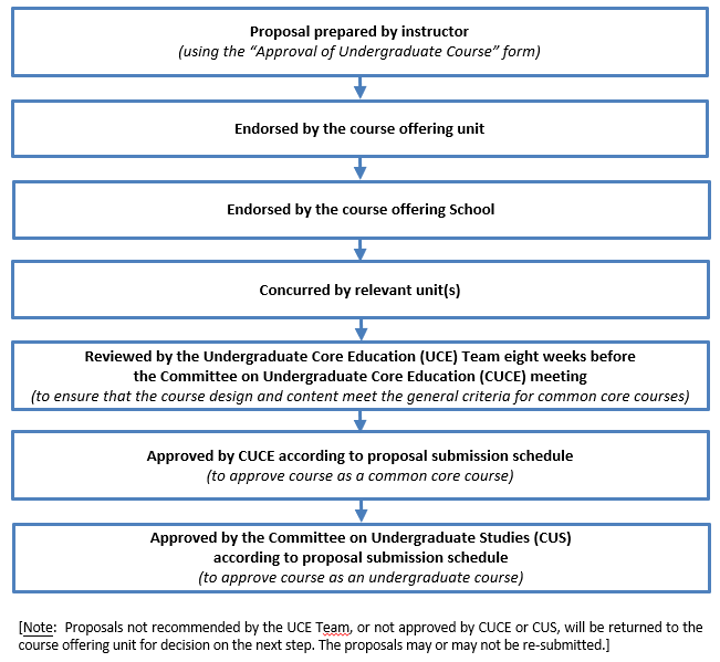
The course offering School submits the course proposal to the Undergraduate Core Education (UCE) Team, after it has been endorsed by the School and concurrences from all relevant units have been obtained.
All course proposals will be reviewed by the UCE Team to ensure that the course design and content meet the general criteria established for common core courses and align with the stated learning outcomes. Any comments or suggestions from the UCE Team aimed at clarifying or improving the proposal will be communicated to the course offering School for consideration in revising the proposal. The Academic Director (UCE) will provide a final recommendation for each new common core course proposal, which will then be submitted for consideration by CUCE. For course proposals where course descriptions, ILOs, competencies, or contribution to common core areas are in doubt, advice from the respective Course Review Panel (CRP) will be sought. The differing views will be reported to CUCE for a final decision.
The authority of CUCE is to approve a proposed course as a common core course. A common core course can be added to the common core course list and be offered only when it has also approved by the Committee on Undergraduate Studies (CUS) as an undergraduate course.
Proposals not recommended by the UCE Team, or not approved by CUCE or CUS, will be returned to the course offering unit for consideration of the next step. The proposals may or may not be re-submitted.