The mission defines the institutional role and purpose of the Common Core Program (“the Program”); the goals describe the overarching intentions of what the Program strives to achieve; and the objectives specify clearly defined tasks associated with tangible outcomes to be achieved through specific actions. The Mission, Goals, and Objectives are closely aligned with each other.
MISSION
The mission [link to the “Mission” section of “The Program” in Section E] of the Program is to support HKUST’s mission and vision by providing a broad and well-rounded education to its undergraduates that nurtures them to be responsible, ethical, and compassionate citizens with the aspiration and competency to excel in their endeavors.
GOALS
The Program strives to provide undergraduate students with a well-rounded quality education that broadens their horizons, inspires and ignites their passion for learning, and empowers them for lifelong pursuit of excellence. Specifically, the goals of the Program are:
Broadening horizons: to allow students to gain intellectual breadth and an appreciation of intellectual achievements across and beyond the main academic disciplines of their studies
A passion for learning: to spark students’ passion for learning and enhance their higher order intellectual abilities: analysis and evaluation; judgment and critical thinking; defining and solving problems
A lifelong pursuit of excellence: to provide a foundation for students’ life-long development through personal growth, preparation for future careers, and opportunities to make contributions to the community
OBJECTIVES
The objectives of the Program are:
- To broaden students’ knowledge beyond the main academic disciplines: science and technology, social studies, and arts and humanities, such that students can gain intellectual breadth
- To instill knowledge on the human achievements in the arts and culture, the social structures and forms, and the significance of scientific discovery and technical accomplishments
- To spark students’ passion for learning by teaching and learning pedagogies that stimulate them to think for themselves, taking their own routes through the materials, to conduct self-directed research and inquiry, and to communicate their discoveries, explanations, and narratives to others
- To help develop higher-order thinking skills through activities that require students to form and communicate judgments, to apply theories and concepts to unfamiliar situations, or to analyze cases and solve problems
- To stimulate students’ development of skills in the areas of language and communication, quantitative reasoning, and computer literacy
- To nurture the development of students’ attributes including social adaptability, the willingness to accept challenges, and the ability to work independently and in collaboration
- To cultivate the development of responsible, ethical and compassionate citizens who can reflect on personal choices and basic human values, and understand the social and human impact of scientific and technical advances
- To equip students with strategies to manage their lives, contribute to the community, and live up to the expectations that society places on its educated citizens
COMMON CORE FRAMEWORKS AND CURRICULA
The Common Core Program is a vital component of undergraduate education, offering a diverse array of learning opportunities that enhance students’ studies in specialized disciplines. Since its inception in 2012, there have been rapid changes in global technology trends and in the skillsets necessary for future challenges in face of the rising importance of cross-disciplinary studies.
To prepare students for these challenges, the Program has been revamped from its original 36-credit framework to a 30-credit structure. Students admitted before 2022-23 should follow the 36-credit framework, while the 30-credit framework is applicable to students admitted in 2022-23 and thereafter.
Since then, different curricula have been developed for different student cohorts within the 30-credit curriculum through continuous reviews and enhancements designed to effectively equip students for future endeavors in the rapidly changing global landscape.
The various Common Core frameworks and curricula are provided below:
INTENDED LEARNING OUTCOMES FOR COMMON CORE AREAS
Each common core area has clearly defined intended learning outcomes (ILOs), which outline what students should be able to demonstrate upon completing the relevant common core courses.
| Common Core Area | Intended Learning Outcomes | |
| Experiencing Group | ||
| Undergraduate experiential Opportunities Programs (UxOP) | UxOP1 | Demonstrate an understanding and appreciation of a topical issue from the perspective of a researcher, teacher, or knowledge worker |
UxOP2 | Demonstrate critical thinking by analyzing the issue using appropriate methods | |
UxOP3 | Communicate with others having different disciplinary backgrounds in addressing the issue | |
UxOP4 | Articulate and explain their experience and its implications for their own future learning | |
| Broadening Group | ||
| Arts (A) | A1 | Describe the theory and history of the arts, and appraise the practice of the arts |
A2 | Demonstrate artistic literacy, aesthetic sensitivity and cultural awareness | |
A3 | Demonstrate creativity through the practice and application of art skills and conceptual thinking in the arts | |
A4 | Express themselves through various art forms or media | |
| Humanities (H) | H1 | Describe and narrate human phenomena from different perspectives in humanities disciplines |
H2 | Demonstrate appreciation of, and articulate, diverse human values, feelings and reason in various forms of expression | |
H3 | Demonstrate awareness of diversity and an understanding of human cultures | |
| Science (S) | S1 | Describe the nature and development of scientific knowledge |
S2 | Identify and evaluate scientific explanations for a range of phenomena | |
S3 | Explain and apply the basic principles of science and methods of scientific inquiry | |
S4 | Evaluate the social implications of scientific discoveries and developments | |
| Technology (T) | T1 | Demonstrate an appreciation of, and evaluate, the social and philosophical implications of technological development |
T2 | Identify, formulate and solve real life problems using appropriate technologies | |
T3 | Apply the basic principles of relevant technologies in an attempt to design a scientific experiment, tangible system, product or process to meet a specific need in engineering and technology domains | |
T4 | Demonstrate an understanding of professional and ethical responsibility in technological development and its applications | |
| Social Analysis (SA) | SA1 | Analyze key societal issues and behavioral phenomena across different contexts with reference to approaches from social science disciplines |
SA2 | Articulate a reasoned perspective on key societal issues and behavioral phenomena based on understanding of social science theories and research | |
SA3 | Apply social science knowledge through critical inquiry for the betterment of society | |
| Sustainability (SUS) (applicable from 2025-26 curriculum) | SUS1 | Demonstrate an interlinkage perspective and understanding between human development and resource conservation |
SUS2 | Apply an integrated economic-socio-environmental approach in addressing and solving developmental issues | |
SUS3 | Demonstrate awareness of the stewardship of sustainable development | |
| Foundations Group | ||
| Human-AI Co-Creation and Data Literacy (HAIC) (applicable from 2026-27 curriculum) | HAIC1 | Explain foundational AI concepts, such as data, models, and agentic systems, including key capabilities, appropriate uses, limitations, and common sources of error and risk |
HAIC2 | Analyze how AI differs from human cognition and apply strategies to collaborate with and orchestrate AI tools/agents in individual and group decision-making, using evidence- and data-informed judgment | |
HAIC3 | Evaluate the role of AI in society as a complex socio-technical system, including multi-agent dynamics, incentives, power, bias, privacy, wellbeing risks, and governance approaches, using evidence- and data-informed judgment | |
| Cognitive Foundations of University Education: Critical Thinking and Data Literacy (CTDL) (applicable from 2022-23 to 2025-26 curricula) | CTDL1 | Evaluate and justify claims critically using analytical skills, data, and evidence |
CTDL2 | Analyze problems and make and articulate decisions critically based on data and evidence | |
| Behavioral Foundations of University Education: Habits, Mindsets, and Wellness (HMW) | HMW1 | Identify strategies to manage physical and mental wellness |
HMW2 | Build sustainable habits that promote personal and interpersonal development in a diverse dynamic environment | |
| English Communication (E-Comm) | E1 | Communicate in English effectively and appropriately in academic, social and/or professional contexts |
| Chinese Communication (C-Comm) | C1 | Develop competency levels of Standard Written Chinese and/or Spoken Chinese in Putonghua |
C2 | Use Standard Written Chinese and/or Spoken Chinese in Putonghua effectively in a specific context or for a specific purpose | |
These area ILOs are aligned with the mission and goals of the Program. They also support the Common Core objectives and are to be achieved through the courses residing in the particular areas. The following tables summarize the mapping between the Common Core objectives and the area ILOs for both the 30-credit and 36-credit Common Core Programs.
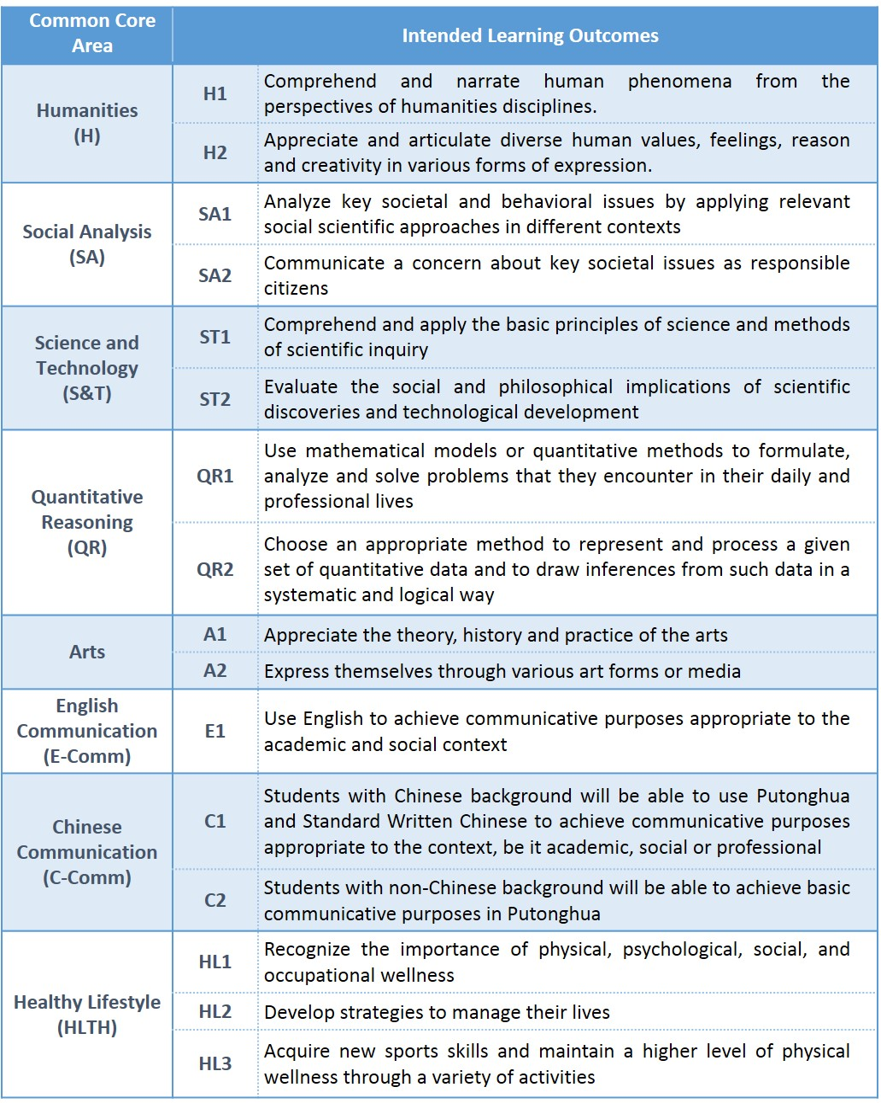
These area ILOs are aligned with the mission and goals of the Program. They also support the Common Core objectives and are to be achieved through the courses residing in the particular areas. The following tables summarize the mapping between the Common Core objectives and the area ILOs for both the 30-credit and 36-credit Common Core Programs.
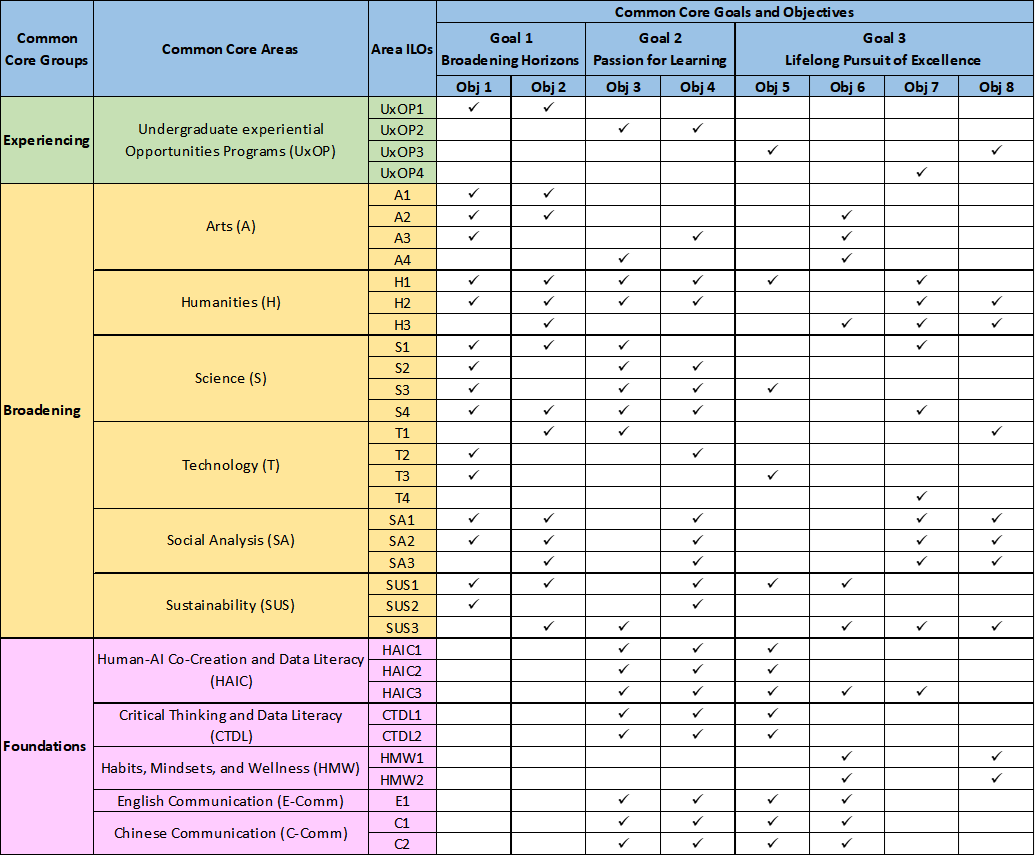
OBJECTIVE 1
OBJECTIVE 2
OBJECTIVE 3
OBJECTIVE 4
OBJECTIVE 5
OBJECTIVE 6
OBJECTIVE 7
OBJECTIVE 8
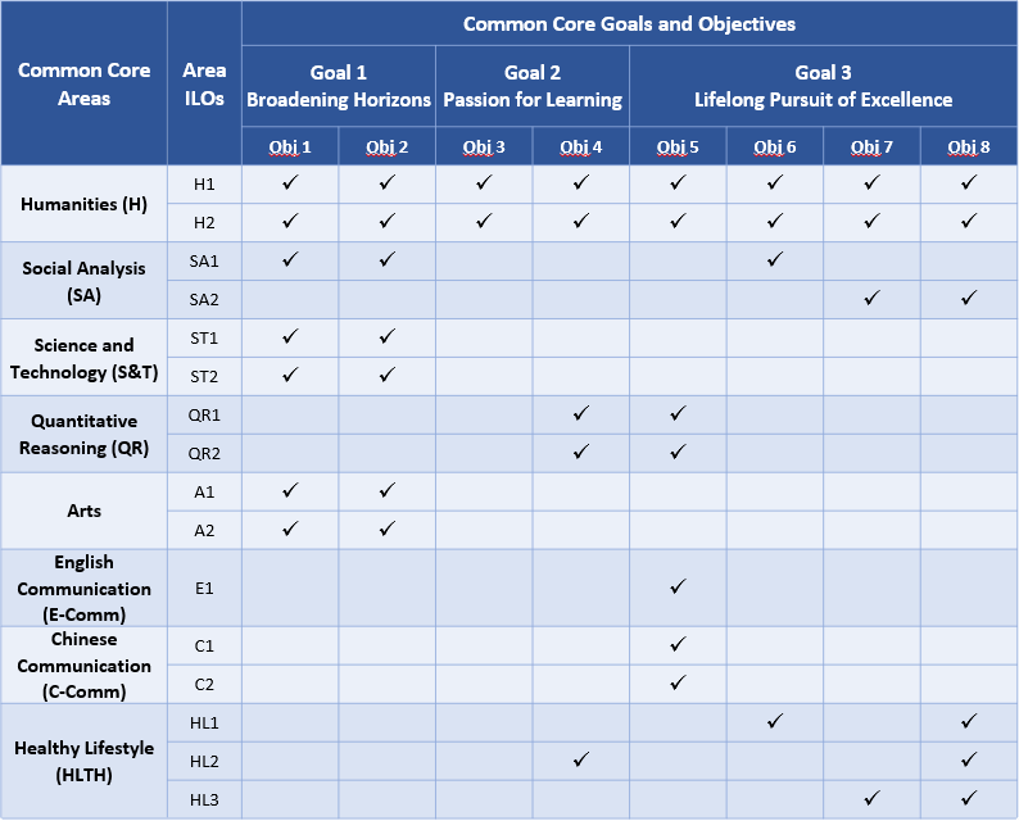
OBJECTIVE 1
OBJECTIVE 2
OBJECTIVE 3
OBJECTIVE 4
OBJECTIVE 5
OBJECTIVE 6
OBJECTIVE 7
OBJECTIVE 8
COMMON CORE AND THE DESIRED ATTRIBUTES OF HKUST GRADUATES
The University aims to provide education that helps its undergraduate students to develop broad graduate attributes, ABC LIVE: Academic excellence, Broad-based education, Competencies and capacity building, Leadership and teamwork, International outlook, Vision and an orientation to the future, and Ethical standards and compassion.
The goals, objectives, and area ILOs of the Program tie in well with these desired attributes. In particular, the Common Core serves to enhance academic breadth (B); foster the development of high-level competencies (C); and employ a pedagogy that promotes personal development, moral reasoning, and responsible citizenship (LIVE).